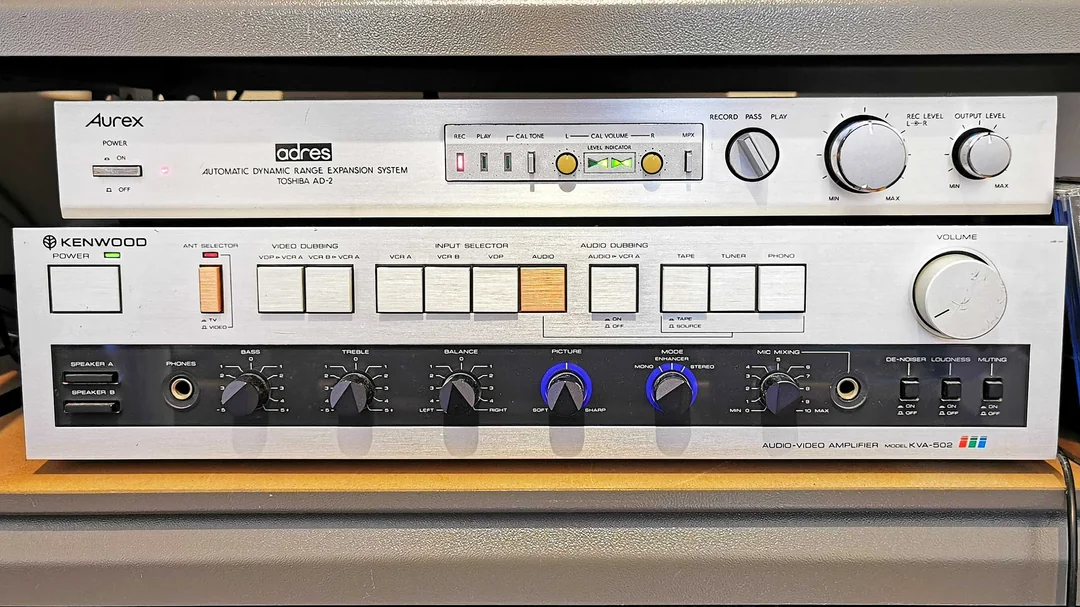


The Aurex AD-2 is an add-on tape processor unit - designed to be inserted in between a tape deck and an amplifier, and functioning as a dynamic range expansion and noise reduction system for cassette decks that didn't include it onboard. Aurex was Toshiba's hifi/high end brand name, much like Panasonic sold products as Technics, throughout the late 70s and 80s. The AD-2 was one of a line up of machines using Toshibas own ADRES, or Automatic Dynamic Range Expansion System, and was the cheapest and lowest end in the lineup, which went up to AD-5. ADRES was also included built into some of Aurex's own cassette decks, in which case you would not need an external box such as this.
Operation of the unit is a little odd, and recommends recalibration of the levels on every recorded tape. To correctly use the AD-2 to record a tape with ADRES, follow the steps below:
- Set the AD-2 to "record" mode, and press the "cal tone" button to generate a calibration tone
- Set your cassette deck recording level to read -3dB, then record 10ish seconds of the tone
- Set the AD-2 to "play" mode, rewind your tape, and play back the calibration tone on the tape
- Adjust the small left and right "cal volume" knobs until both triangular lights stay lit - this indicates a signal of -3dB.
- Set the AD-2 back to "record" mode, and play your music, adjusting its onboard "rec level" knob until it indicates around or under -3dB.
- Record the remainder of your tape. Do not adjust the record levels on your cassette deck, even though they look very low
The calibration tone does need to be present at the start of the tape - when playing back an already recorded tape, follow the following procedure:
- Set the AD-2 to "play" mode, and begin playing the tape on your cassette deck
- During the calibration tone, adjust the "cal volume" knobs until both lamps stay evenly lit
- Sit back and enjoy your tape
Toshiba's manuals seem to heavily encourage including this calibration tone and adjusting the cal volume for every single different formulation of tape you may use - ie if you switch from a Maxell chrome tape to a TDK chrome tape, you are supposed to readjust it every single time. They do also seem to encourage recording lower rather than higher - it seems they're so confident in ADRES ability to remove noise that they'd prefer you record down in the noise floor than even approach overloading your tape. I do tend to set the levels on the AD-2 itself a little higher than the manual recommends, but I do leave the cassette deck levels alone after calibration, despite how concerningly low they seem.
History
Magnetic tape inherently has a certain amount of background noise, or hiss, due to the varying magnetic levels of the particles even when they are completely erased/non-recorded. Dolby laboratories got their start by designing external electronic boxes that can reduce this hiss. It's mostly in the high frequencies, so by lowering high frequencies on playback, you remove the hiss - but you'd also remove the high frequencies from your desired sound, so they boost those high frequencies on the source signal before it's recorded to tape - meaning the "reduction" gets rid of the hiss, but brings the music back to normal. This technology essentially gave them a money printer - by licensing out their circuit design to cassette deck manufacturers, almost every cassette deck featured Dolby B noise reduction, and as a result almost every cassette deck paid Dolby a little bit of licensing money.
This inspired a lot of companies to design their own noise reduction systems. Most famously, JVC created "ANRS", the automatic noise reduction system, which was compatble enough to play back Dolby encoded tapes, but different enough that they could avoid paying those licensing fees. This machine, the Aurex (Toshiba's high end hifi badge) model AD-2, instead uses their proprietary ADRES system. These add-on boxes are designed to be connected to a cassette deck that doesn't feature this noise reduction system, so you can experience their design instead of being stuck with Dolby. While Dolby's systems worked by shifting the frequencies of the music, ADRES - standing for Automatic Dynamic Range Expansion System - works with dynamic range, the range between the loudest and quietest signals. Tape hiss is at a very low level - so, for example, in a loud section of your music, it will be practically inaudible as it only makes up 5% of the signal, but in quiet sections it can make up half of what you're hearing. By making the quietest parts louder during recording, they avoid this noise floor, and then lowering them back down on playback pushes the hiss down to being entirely inaudible.
The ADRES system goes about this in a fairly complex way - I don't fully understand it, but it seems that the degree of compression (how much the dynamic range is reduced on recording) varies both depending on the frequency and overall volume, and is in sliding "bands". Looking at the circuitboard below, there do seem to be a few custom Toshiba designed ICs, though overall it's not hugely complicated looking as a device - evidently they succeeding in making the AD-2 their low cost entry in the lineup. Having tested it and wired it up to my cassette deck, it really does sound great, the degree of noise reduction is impressive, and the typical "pumping" of dynamic range expansion systems is present, but I didn't find it very obtrusive at all (not that I've ever tried any other systems for comparison as of yet)


